B2B vs B2C Ecommerce Development: Understanding the Right Ecommerce Model for Your Business
However, there are some key differences in the way how a business can sell their goods to wholesale and end-users.
A business website targeting business buyers will have significantly different requirements as compared to a consumer website.
That’s why it is important to understand the B2B vs B2C Ecommerce Development before you start building an online store.
B2B ecommerce deals with selling products and services between businesses, while B2C deals with individual customers. The two require a website with a user-friendly interface, secure checkout, mobile-friendly design, product catalog, and other essential features. However, the two types of business may experience a different buying process, have different pricing structures, and provide different sets of features to their customers.
GrowthWeb Digital can help companies develop an ecommerce solution for their specific business model, customers, products, selling process, and other requirements.
What Is B2B Ecommerce Development?
B2B stands for business to business.
B2B ecommerce development deals with online transactions between businesses.
Examples of B2B ecommerce include:
• Manufacturer to Distributor
• Wholesaler to Retailer
• Supplier to Corporate Buyer
• Exporter to Business
• Distributor to Dealer
A B2B website often requires more complex buying process and additional features as compared to a standard B2C online store.
Many businesses operate on a larger scale and a single purchase can include hundreds or thousands of products. Business buyers may also negotiate commercial terms and purchase goods with different payment conditions.
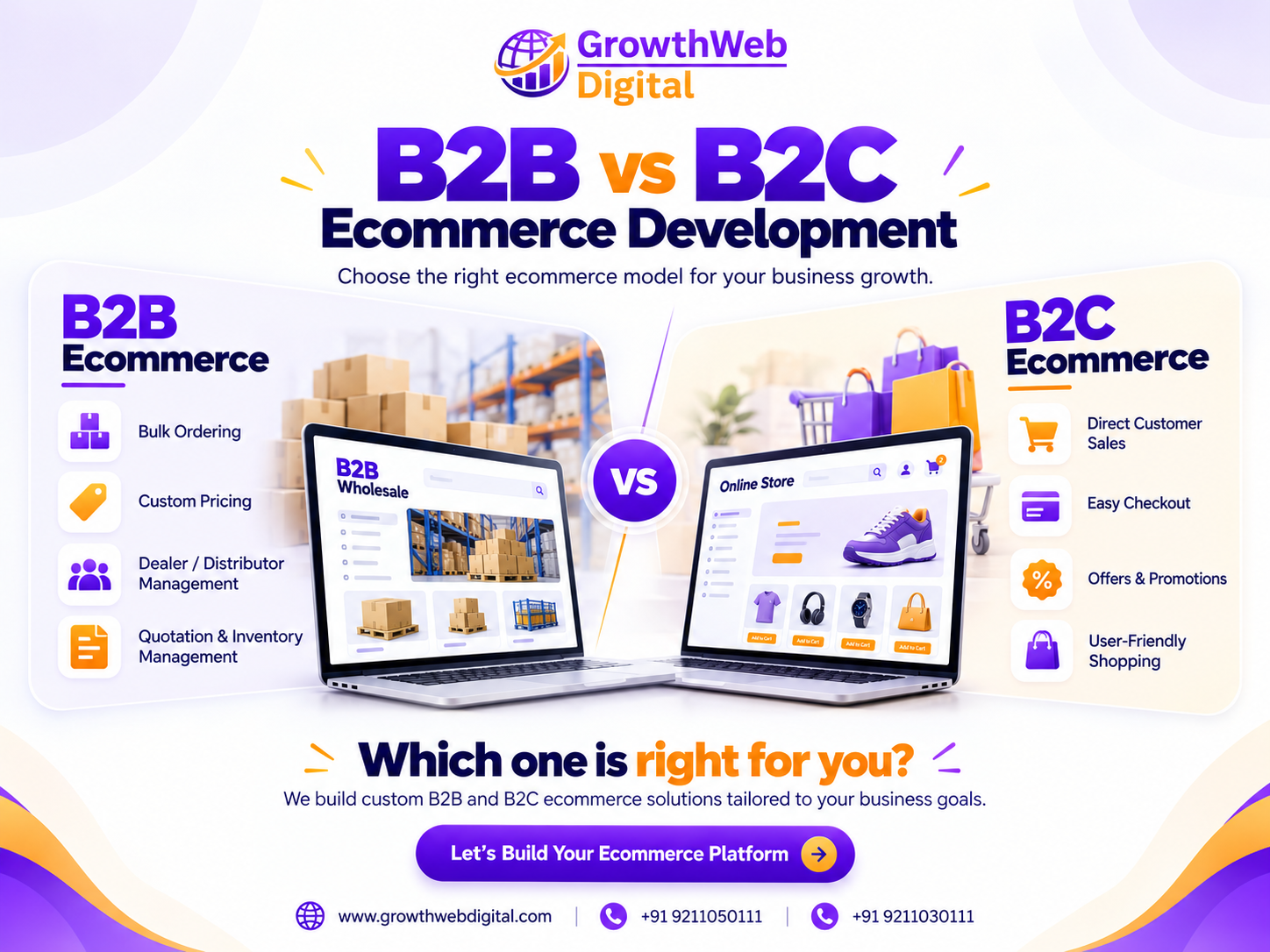
Some common B2B ecommerce development features include:
• Bulk Order
• Minimum Order Quantity
• Dealer Access
• Customer-specific Pricing
• Wholesale Pricing
• Quotation
• Repeat Order
• Credit Terms
• Product Catalog
• Role Specific Customer Accounts
The ultimate objective is to make the buying process as streamlined as possible for business buyers.
What Is B2C Ecommerce Development?
B2C stands for business to consumer.
B2C ecommerce development deals with online transactions between businesses and individual customers.
Examples of B2C ecommerce include online stores selling:
• Clothing
• Electronics
• Cosmetics
• Furniture
• Shoes
• Food
• Home Decor
• Consumer Goods
A B2C website is usually focused on an enhanced customer experience, engaging visuals, intuitive navigation, and a seamless checkout process.
Some common B2C ecommerce development features include:
• Product Categories
• Wishlist
• Shopping Cart
• Coupons
• Customer Accounts
• Online Payments
• Reviews
• Order Tracking
• Offers
The ultimate objective is to make it easy for consumers to discover products, add items to their cart, and complete their purchase.
B2B vs B2C Ecommerce Development: The Main Difference
The most significant difference between B2B and B2C ecommerce is who the customer is.
A B2B ecommerce website sells products and services to other businesses, while a B2C ecommerce website sells goods or services to individual consumers.
This key difference highlights the fact that many features in B2B and B2C websites may be significantly different.
For example, an individual customer will have a very different buying process as compared to a distributor.
While a customer can purchase a single pair of shoes with a few mouse-clicks, a wholesale distributor may have to send an email, request a quotation, and negotiate terms and conditions prior to buying 2,000 pairs of shoes.
As the user journey of a business buyer and a regular consumer is very different, their website experience should be different as well.
1. Difference in Target Audience
Business-to-business ecommerce platforms are usually aimed at dealers, distributors, wholesale buyers, and other business customers.
On the other hand, business-to-consumer ecommerce platforms are aimed at individual customers and end-users.
A B2B website may offer more information about the product specifications, whereas a B2C website may focus on engaging visuals and a strong call-to-action.
Understanding your target audience is one of the key factors in developing an ecommerce platform.
2. Pricing Structure
Pricing is one of the most significant differences between B2B and B2C ecommerce.
A B2C website usually displays one uniform selling price for each product.
There may be special offers and discounts, but the base price is the same for every customer.
However, in a B2B environment, the final price can vary dramatically depending on various factors.
Some of the common variations in pricing structures include:
• Purchase quantity
• Customer category
• Dealer level
• Business agreement
• Location
A B2B website may require special pricing for different categories of buyers.
3. Bulk Ordering
Business buyers often purchase goods in large volumes.
That’s why many B2B platforms offer functionality for bulk ordering.
As such, a business may not need to manually add products to the cart – there are often special fields for quantity, SKU, repeat order, etc.
In contrast, individual consumers rarely purchase in large volumes, so an online store will normally offer a straightforward shopping cart.
4. Minimum Order Quantity
Many manufacturers and wholesale suppliers offer their goods only in minimum order quantities.
For example:
Minimum Order Quantity: 100 Pieces
A B2B online store can restrict the ability to make a purchase below the minimum order quantity.
However, a B2C website will normally allow an individual customer to purchase a single unit.
5. Request for Quotation
Individual customers are ready to buy, but business buyers sometimes request a quotation before finalizing their purchase.
A B2B website can offer the ability to submit a request for quotation.
In many cases, buyers will add products to the cart, select a quantity, enter their specifications, and send the request to the seller. The seller will then evaluate the request and reply with an official quotation.
However, the same process is not used in B2C ecommerce platforms.
6. Customer Registration and Approval
A B2C account registration is a simple process.
A customer only needs to enter their name, email address, and password to create an account.
However, a B2B account requires more information, such as GST, business name, business type, contact person, and other details.
Furthermore, a registered B2B user may need to wait for the approval before they can view wholesale prices and make a purchase.
This additional step is required to ensure that only approved business buyers can register on the website.
7. Ecommerce Website Design
B2C ecommerce design is normally more focused on engaging visuals and a customer-centric approach.
High-resolution imagery, banners, special offers, and other marketing elements play an important role.
A B2B website, on the other hand, is normally focused on streamlined functionality, informative product descriptions, and a strong specification sheet.
That doesn’t mean that a B2B website can’t use high-resolution photos and banners – but the ultimate focus should be on a streamlined buying process.
8. Product Information
B2B products normally require much more information than B2C products.
For example, a typical product page for business buyers can include:
• Model
• Size
• Dimensions
• Packaging
• MOQ
• Technical Specifications
• Catalogue (downloadable)
In contrast, a product page for individual customers will normally focus on key specifications, benefits, images, variants, and other elements.
The product information should be tailored to the target audience and the purpose of the website.
9. Payment Options
A B2C ecommerce platform is normally focused on immediate online payments.
The most popular payment options include UPI, debit card, credit card, net-banking, wallet, cash on delivery, and others.
However, a B2B ecommerce website should consider alternative payment options, such as bank transfer or credit/debit payment terms.
A business-to-business transaction may also include a purchase order or special agreements with buyers.
10. Order Approval
In some cases, business buyers require additional approvals before finalizing an order.
For example, an employee may create the order, but the manager needs to approve it before the purchase can be finalized.
A custom B2B ecommerce platform can be developed with the necessary tools to support the internal ordering process.
This type of functionality is normally not required in a B2C website.
11. Repeat Ordering
Business buyers normally order the same products repeatedly.
Instead of reordering the same items again and again, it is important to streamline the process with repeat ordering functionality.
A business-to-business website can offer such features as reorder, order history, wishlists, and others.
A business-to-consumer website can also include such functionality, but it is much more relevant in a B2B environment.
12. Search and Product Filters
The search functionality on a B2B ecommerce site and a B2C website may appear similar on the surface.
However, a business-to-business buyer will normally use more specific searches as compared to an individual customer.
For example, a B2C customer can search for the following:
• Price
• Size
• Color
• Brand
• Rating
A B2B buyer, on the other hand, can use such product filters as:
• Model
• Material
• Type
• Industry
• Specification
• Feature
It is important to highlight the difference between search terms and filters.
13. Inventory Management
Inventory management plays a critical role in both B2B and B2C ecommerce platforms.
The ultimate goal is to ensure that the website reflects the actual stock quantity.
A B2B order can include hundreds or even thousands of units, so it is important to make sure that the website offers robust inventory management options.
Inventory management systems can also include additional tools, such as ERP, warehouse management, and internal databases, to ensure proper synchronization.
14. B2B Ecommerce for Manufacturers
Business-to-business ecommerce platforms can be very beneficial for manufacturers.
A digital catalog can effectively market products to end-buyers.
Furthermore, a B2B ecommerce website can effectively collect information from business buyers and help manufacturers optimize their sales processes.
Such tools as dealer portals, product catalogues, repeat ordering, request for quotation, and custom pricing can significantly improve the manufacturer’s offline purchasing experience.
15. B2C Ecommerce for Retail Brands
A business-to-consumer website is normally the best choice for retail brands and consumer product companies.
Such companies can use a B2C website to effectively showcase their products and facilitate direct sales.
The key focus should be on an enhanced customer experience, intuitive ordering process, mobile design, engaging visuals, and secure payments.
The ultimate objective is to reduce barriers to entry and ensure that the customers can make a purchase with minimum effort.
16. Mobile Experience
A mobile-responsive design is essential for both B2B and B2C ecommerce.
B2C customers are more likely to use the website on a mobile device.
However, business buyers can also use a mobile website to check inventory, place an order, or monitor the status of the existing order.
A responsive design should ensure that menus, product pages, order forms, shopping cart, and checkout process are accessible on all devices.
17. SEO for B2B vs B2C Ecommerce
Search engine optimization is an important consideration for both B2B and B2C ecommerce platforms.
However, the strategy and execution can be significantly different.
Keyword research for B2B ecommerce can include terms such as:
• Manufacturer
• Supplier
• Distributor
• Bulk Supplier
B2C ecommerce platforms focus more on product and purchase-related keywords, such as:
• Buy Online
• Find the Best
• Product Price
An effective SEO strategy should also include optimization of URL structure, product descriptions, category tags, website speed optimization, and internal linking.
SEO should be considered at every stage of website development.
18. Marketing Strategy
A successful B2C ecommerce website normally relies on Google Shopping, ads, social media marketing, influencer outreach, retargeting, and other marketing activities.
B2B ecommerce marketing is normally more focused on SEO, Google Search Ads, email marketing, content marketing, and lead generation practices.
The overall marketing mix will depend on an industry, audience, budget, and other factors.
19. B2B Ecommerce Development Cost
The cost of developing a business-to-business ecommerce website depends on the required features and tools.
A website selling products to other businesses will normally be more complex than a simple consumer directory.
A higher level of complexity will be reflected in the final cost.
The most effective approach to estimating B2B ecommerce development costs is to consider the required features and tools.
20. B2C Ecommerce Development Cost
The cost of a B2C ecommerce solution depends on a variety of factors, including number of products, design requirements, payment gateway, shipping options, features, and technology.
A simple online store will normally have a lower price as compared to a fully customized marketplace solution.
Which Ecommerce Model Is Right for Your Business?
Choose a B2B ecommerce solution when your primary customers are business buyers, such as dealers, wholesalers, distributors, corporate buyers, and others.
Choose a B2C ecommerce solution when you sell your goods and services to individual consumers.
Some companies need to support both B2B and B2C sales, so it is important to design a website around these specific requirements.
For example, a manufacturer may sell their products to dealers on a wholesale basis and operate a separate B2C website for end-users.
In such cases, a hybrid website with separate selling processes and pricing can be much more efficient.
B2B vs B2C Ecommerce Development – GrowthWeb Digital
GrowthWeb Digital can help you select a custom ecommerce development solution for your specific business model, audience, products, and other requirements.
Ecommerce development services include:
• B2B Ecommerce Development
• B2C Ecommerce Development
• Custom Ecommerce Development
• Multi-Vendor Ecommerce
• Wholesale Ecommerce Platforms
• Product Catalogue Systems
• Payment Gateway Integration
• Order Management
• Dealer Portals
• Responsive Ecommerce Websites
The focus is on building an ecommerce platform around your unique needs and providing a streamlined buying experience for your customers, as well as practical tools for managing your products, sales, and enquires.
Common Ecommerce Development Mistakes
Avoid the following ecommerce development mistakes:
• Picking out the technology first
• Poor mobile design
• Complicated checkout process
• Ineffective search and filters
• Slow page loading
• No security
• Poor inventory planning
• No SEO structure
An ecommerce website should be built around the customer experience.
Conclusion
Understanding the difference between B2B and B2C Ecommerce Development is essential because the two types of ecommerce business sell to completely different customers.
B2B ecommerce focuses more on business buyers, larger order sizes, special pricing, quotation process, and dealer management. B2C ecommerce focuses on individual customers, product presentation, online payments, and streamlined buying process.
There is no such thing as a better ecommerce option. It is important to analyze your customer segment and selling process, and choose a website development solution accordingly.
If your business operates in a B2B environment, needs a B2C online store, requires a wholesale portal, or a multi-vendor solution, GrowthWeb Digital can help you build an ecommerce platform that fits your specific requirements.
📞 +91 9211050111 | +91 9211030111
🌐 www.growthwebdigital.com