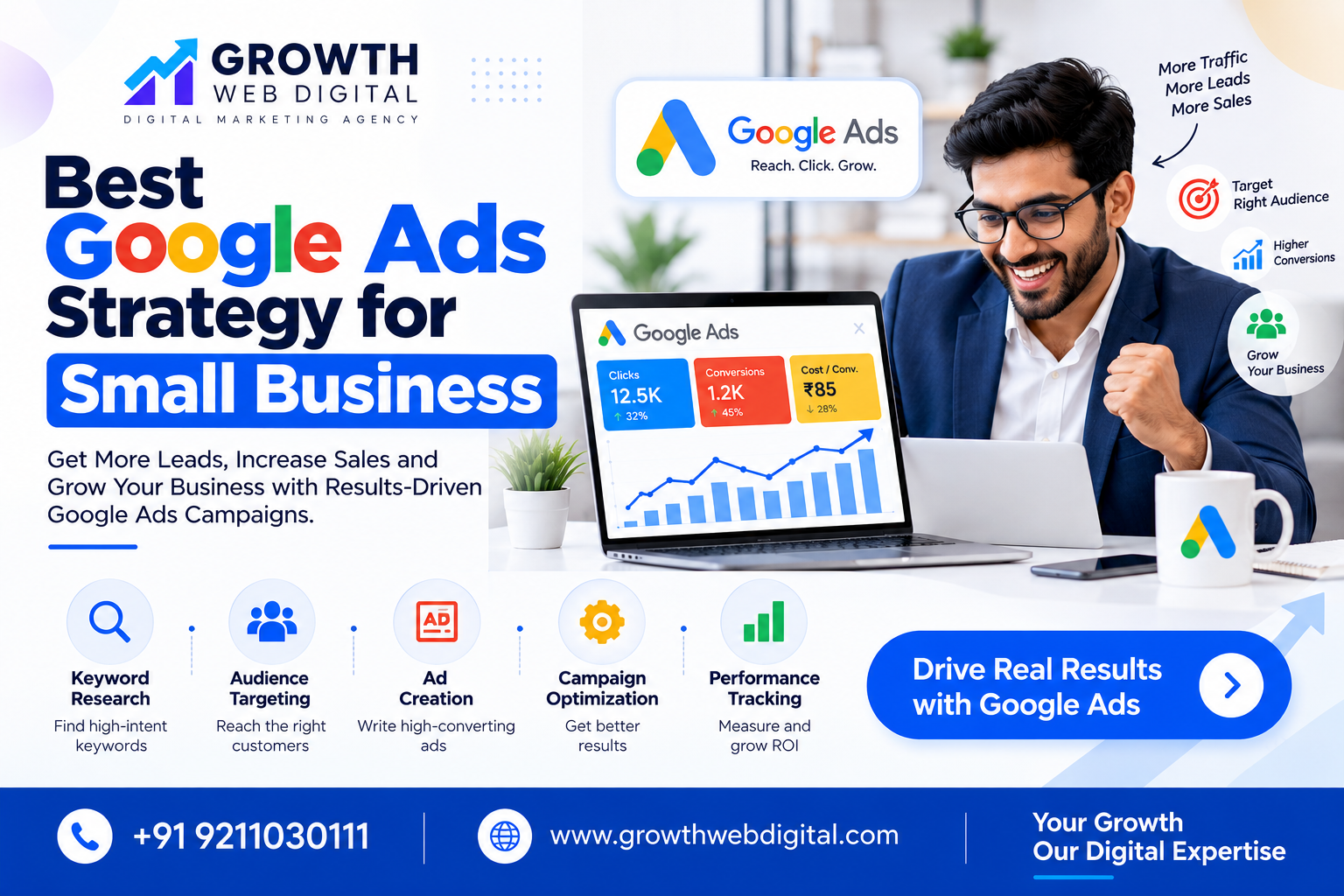
Best Google Ads Strategy for Small Business: Guide to Boost Leads
Therefore, the Best Google Ads Strategy for Small Business becomes crucial.
Google Ads strategy should focus on targeting the right set of audience, using high-intent keywords, tracking budget, creating effective ads, optimizing landing pages, and tracking conversions. It’s not about driving traffic but generating high-quality enquiries, calls, sales, or bookings at a lower cost.
Let’s discuss the best Google Ads tips for small businesses to create a profitable Google Ads campaign.
Best Google Ads Tips For Small Business
Google Ads lets you target the audience which is actively searching for your services or products. For example, if you are a local business and your website selling services in your local area, your target audience would be searching for queries like:
Website development company near me
- SEO services in Delhi
- AC repair near me
- Best dentist in Delhi
- Ecommerce website development
- Interior designer near me
etc.
Unlike conventional marketing, Google Search Ads allow small businesses to engage with customers at the time when they are actively searching for a business like yours. This can be extremely beneficial for any small business if the Google Ads campaigns are created correctly.
1. Set Google Ads campaign’s goal
Firstly, before creating a Google Ads campaign, think about the purpose of your campaigns.
For example, your goal can be:
- Generating sales
- Generating enquiries
- Generating WhatsApp messages
- Generating phone calls
- Leads generation
- Offline store visits
- Quote generation
Store visits, and so on.
Based on the goals, the whole campaign structure will change. If the goal is to generate website traffic, it’s a good start but don’t forget that a click on the ad is not a lead. Always think about what you want to achieve by running Google Ads.
2. Use high-intent keywords
Small businesses should avoid using broad keywords. Focus on high-intent keywords. High-intent keywords are more likely to drive conversions.
For example,
instead of using the keyword
website
use
website development company in Delhi.
Similarly,
instead of using the keyword
SEO
use
SEO services for small business
and so on.
3. Use location targeting
When it comes to the Best Google Ads Strategy for Small Business, location targeting plays a critical role.
Only target locations where your business is present or operating. For example, if you are a local business based in Delhi NCR and you are targeting only customers based in Delhi NCR, there is no point in targeting the whole of India on your Google Ads campaign. You can choose to target:
- Delhi
- Noida
- Gurugram
- Faridabad
- Ghaziabad
- Specific area
Certain radius from your business address, and so on.
4. Use Negative keywords
Certain searches might trigger your advertisement, however, they might not necessarily be relevant to your business. In order to avoid wasting your budget on irrelevant searches, use negative keywords. For example, if you are in the business of selling website development services, you would want to avoid targeting searches such as:
- Free website builder
- Website development course
- Website development jobs
- Website templates free
- Learn web development
etc.
Always review search terms regularly and mark irrelevant terms as negative keywords.
5. Create separate campaigns for different services
Avoid putting all your eggs into one basket. Suppose you have multiple services to sell, create separate campaigns for every service. For example, if you are a digital marketing agency offering services such as:
- Website Designing
- SEO
- Google Ads
- Meta Ads
- Mobile App Development
etc.
you will need a separate campaign or ad group for every service. Never put all your services into one ad campaign. This way, you can have greater control over your ads. For example, someone searching for SEO services wouldn’t be interested in a mobile app development ad.
You can create more specific:
Keywords,
Ads,
Landing pages,
And budgets.
6. Write relevant advertisements
Your advertisements should be relevant to the searched terms. A good Google Search Ad will have the following elements:
- Service or product
- Location
- Benefit
- Call to action
For example, a good Google Search Advertisement for a website development company might look like:
- Website Development Company in Delhi
- Custom, Responsive & SEO-Friendly Websites
- Get a Free Consultation Today
Avoid using irrelevant words, keep your advertisement relevant and straight to the point. The user should be able to understand what you are selling within seconds.
7. Effective call to action
Your CTA (Call to Action) should encourage users to take the desired action. Your CTA can be something like:
- Call now
- Get a Quote
- Get a consultation
- Book an appointment
- Contact us
- Get started
etc.
Make sure to have an effective CTA based on your business need. For example, for generating phone calls, you can ask your users to ‘Call Now’.
8. Effective Landing Page
Avoid sending your advertisement traffic to your homepage. The next most important thing after advertisements is the landing page. Always try to send your users to a relevant landing page.
For example,
if your Google Ad is for an SEO Company in Delhi, the landing page should be a SEO Service page and not the homepage. Your landing page should have:
- Headline
- Service description
- Benefits
- Trust factors
- Contact form
- CTA button
- Phone number
The landing page should be relevant to the advertisement, this will increase your chances of converting a visitor.
9. Fast landing page
Google Ads landing page speed plays a significant role. Users tend to leave if a webpage takes too long to load. Therefore, it’s essential to optimize your landing page speed. You can optimize the landing page speed by:
Compressing images
Minifying code
Upgrading web hosting,
etc.
Mobile landing page speed is even more crucial as majority of users access the internet through their mobile phones.
10. Mobile-friendly landing pages
Landing pages should also be mobile-friendly. Make sure the font size, buttons, and forms are readable and clickable on mobile phones. Always keep in mind that users are more likely to contact your business if they can click on your phone number easily on their mobile phones.
Google Ads landing page optimization tips can drastically improve your conversion rate.
11. Track conversions
Google Ads without conversion tracking is incomplete. Always track the most relevant conversion for your business. A conversion can be defined as:
- Contact form submission
- Phone call
- WhatsApp enquiry
- Purchasing a product
- Booking an appointment
- Quote request
- and so on.
By tracking conversions, you will be able to improve your Google Ads campaigns by identifying which keywords, advertisements, and campaigns are driving conversions. You shouldn’t judge your Google Ads campaign’s success by the number of clicks but by the number of conversions. Always track what matters to you the most.
12. Track phone calls
Phone calls are extremely valuable for local and service-based businesses. Therefore, if you are a local business, make sure to track calls. You can track:
- Calls from Google Ads
- Click to call
- Calls from website
etc.
Tracking phone calls will improve your understanding of how your Google Ads campaigns are performing.
13. Set a realistic daily budget
A small-scale business doesn’t need a huge daily budget. Set your daily budget keeping in mind:
- Industry
- Keyword competition
- Location
- Value of a lead for your business
etc.
Avoid distributing your small daily budget among multiple ad campaigns. For example, if you have a small daily budget, it’s better to run your ads for two core services rather than running ten different campaigns.
14. Search Ads (Google Search Network)
Google Search Network is a great platform for any small business to gain visibility among its target audience. Google Search Network is comparatively cheaper and easier to optimize for small businesses. You should start with Google Search Ads because of the following reasons:
Target your ideal customers
Focus on high-intent keywords
Higher chances of conversion
Once you are comfortable with Google Search Ads, you can experiment with other Google Ads campaign types like remarketing, display ads, performance max, video, etc.
15. Optimize ad schedules
Not everyone is interested in your service 24/7. For example, you will get better results if you run your ads during working hours. Always optimize your ad schedule based on clicks and conversions. You should avoid running ads during off-peak hours. This will improve your chances of generating quality leads within your limited budget.
16. Search terms
The search terms report reveals the keywords that triggered your advertisements. Always review your search terms and identify keywords that can be:
Useful
Irrelevant
Or triggering your ads unintentionally.
This is one of the best Google Ads optimization tips as it allows you to enhance your campaign structure and discover new keywords to target.
17. Quality score
Google Ads quality score should be given much importance. Google Ads rewards campaigns with a higher quality score by reducing cost-per-click (CPC). A higher quality score can be achieved by:
- Enhancing campaign structure
- Using relevant keywords
- Creating relevant advertisements
- Improving landing page experience
Avoid creating irrelevant advertisements. Make sure the advertisement is relevant to the searched terms. For example, a single advertisement shouldn’t target every keyword. Use different advertisements for different sets of keywords.
18. Use ad assets
Google Ads offers various ad assets that can improve your advertisement. Some examples of ad assets are:
- Call assets
- Sitelinks
- Callouts
- Structured snippets
- Location extension, etc.
Always use ad assets to improve your advertisements, especially call assets. If your business has a phone number, make sure to include it in your advertisement.
19. Test different ad copies
Don’t run the same advertisement for an extended period. Test different advertisement variations and keep the one that is performing the best. Always create advertisements with unique selling propositions (USPs). For example,
Affordable Website Development in Delhi
vs
Custom Website Development for Growing Businesses.
Keep testing your advertisements and use the best performing advertisement.
20. Focus on quality leads, not quantity
This is one of the best Google Ads tips for small businesses. Let’s say, you are getting 50 leads for ₹300 per lead and 20 leads for ₹500 per lead, you should focus on the campaign that is providing you with quality leads. In this example, the first campaign with 50 leads will appear to be performing better however, it’s crucial to keep an eye on the conversion rate. These 50 leads may turn out to be cheaper than the 20 leads and vice versa. Always keep track of:
- Leads,
- Sales,
- Conversion rates,
- Revenue per lead,
etc.
21. Use remarketing
Remarketing is a great way to re-engaging with your past website visitors. Not everyone will convert on their first visit to your website, therefore, it’s essential to use remarketing to encourage these website visitors to take action. Remarketing can be used for:
- All website visitors
- Cart abandoners
- People who visited a specific page
- Previous leads, and so on.
Remarketing should be used in addition to your core Google Search Ad campaigns.
22. Optimize for mobile and desktop
People visit websites from different devices, for example:
- Mobile,
- Desktop,
- Tablet, and so on.
You can optimize your website for the device that is driving the best results for you. For example, if you are getting more leads from mobile users, then you should optimize your landing page for mobile users.
23. Cost per lead (CPL)
Cost per lead is one of the most important metrics for service providers. For example, if you spent ₹20,000 and got 40 leads, then your cost per lead (CPL) is ₹500 (20,000/40). Always keep an eye on your CPL. However, you should also analyze the sales, for example, if your CPL is ₹500 but every customer is spending an average of ₹20,000, it means you are making a profit.
24. Avoid making multiple changes
Small businesses tend to make multiple changes at once. For example, they tend to:
- Change keywords
- Edit budget
- Create new advertisements
- Change bids
- Create new landing pages
etc.
This makes it difficult to understand what is working and what isn’t. Always make changes one at a time and analyze the results.
25. Google Ads for Local Small Businesses
Google Ads can be extremely successful for local small businesses, for example, local clinics, repair services, coaching institutes, interior designers, local stores, service providers, etc. Local business owners should use location-based Google Ads campaigns to target customers in their local area. A local campaign will consist of:
- Location,
- High-intent keywords,
- Call,
- And landing page with trust factors.
For example, a dentist in Delhi will have better results by targeting
- dentist in Delhi
- rather than
- dentist
26. Google Ads for Ecommerce Small Businesses
Ecommerce businesses need to focus on driving sales. Your Google Ads campaigns should be focused on product pages and conversion rate optimization. Ecommerce businesses should always keep the following in mind:
- Conversion tracking,
- Purchase value,
- Mobile optimization,
- Product feed optimization (if using shopping ads),
- Remarketing, and so on.
Common Google Ads Mistakes Small Businesses Must Avoid
Small businesses must avoid the following Google Ads mistakes:
- Irrelevant targeting
- Ignoring negative keywords
- Sending prospects to the homepage
- No conversion tracking
- Landing page optimization
- Only measuring clicks
- Wide location targeting
Wide budget distribution (budget spent on too many campaigns)
- Ignoring mobile users
- Not reviewing search terms
Good campaign management is all about saving money by improving campaign structure and increasing relevancy.
Best Google Ads Strategy for Small Business With GrowthWeb Digital
At GrowthWeb Digital, we provide expert Google Ads campaign management to small businesses. We plan your Google Ads campaigns keeping in mind your business goals, service areas, keyword competition, and budget. A good Google Ads strategy for a small business can include the following:
- Keyword research and search ad campaigns
- Location targeting
- Negative keywords
- Landing page optimization
- Conversion tracking and remarketing
- Campaign optimization, and so on.
For small businesses, it’s important to keep track of conversions like calls, leads, enquiries, sales, and bookings. Your goal shouldn’t be about spending more money but spending your money wisely.
Conclusion
In this article, we discussed the Best Google Ads Strategy for Small Business. Small businesses should avoid vanity metrics and should focus on achieving specific goals like generating calls, leads, sales, and enquiries. A good Google Ads strategy for small businesses should include high-intent keywords, location targeting, effective advertisements, landing page optimization, conversion tracking, and remarketing.
Google Ads can help small businesses compete against big brands, however, it’s important to keep track of money spent and campaign performance. If your small business is looking for Google Ads campaign management, lead generation, conversion rate optimization, landing page optimization, SEO, or remarketing, GrowthWeb Digital specializes in helping businesses generate more enquiries and grow online.
📞 +91 9211050111 | +91 9211030111
🌐 www.growthwebdigital.com