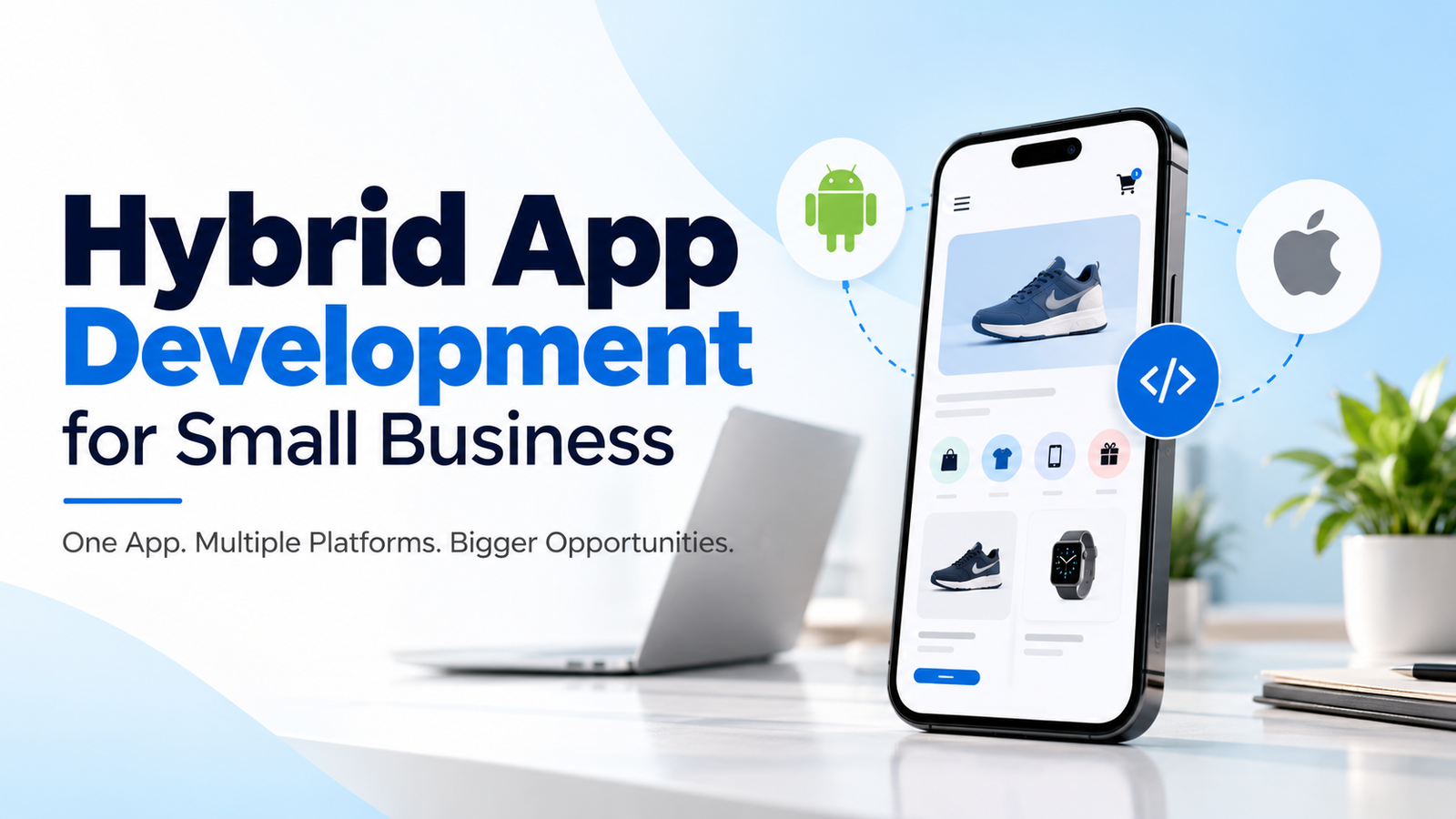
Hybrid App Development for Small Business: Hybrid App Development for Android and iOS
However, developing applications for Android and iOS could be expensive and time-consuming.
Hybrid app development for small business can help you turn your idea into reality.
This method can be especially useful if you want to develop mobile apps with reduced maintenance, improved development time, and the ability to address a bigger user base.
Our team at GrowthWeb Digital can help build a hybrid application according to your business requirements, target audience, and budget.
About Hybrid App Development
Hybrid app development enables you to develop a mobile application that can target multiple platforms from a singular codebase.
Hybrid mobile apps can be developed for:
• Android
• iOS
• Tablets
• Other compatible devices
Modern technologies can enable you to develop mobile apps with similar interfaces and features across multiple platforms.
Some of the most popular frameworks for cross-platform and hybrid application development are Flutter , React Native , and Ionic .
Why Hybrid App Development Is a Good Choice for Small Business
Small businesses usually have a limited budget.
You cannot afford to invest in a resource-heavy enterprise mobile application.
Developing two native applications (one for Android and another for iOS) would require you to double the effort and budget.
Hybrid app development can enable you to build a mobile application with reduced complexity and maintenance.
However, you should keep in mind that your budget will still be influenced by your app complexity, number of screens, features, backend requirements, design, and other factors.
A small utility app will generally be cheaper than an enterprise-level solution.
1. Reduced Development Cost
As mentioned above, hybrid application development has a reduced cost when compared to native application development.
This is because many components are shared between target platforms and do not need to be maintained separately.
This benefit is especially useful for small businesses and startups that want to minimize their development costs.
However, you should keep in mind that a hybrid application is not always cheaper than a native one.
The final cost is influenced by many factors, including the app complexity, number of features, platforms, and many other factors.
2. Faster Development
If you are a small business owner, you may want to get your application on the market as soon as possible.
Hybrid app development can be completed faster than the development of two native applications.
This is because many components are shared between target platforms and do not need to be developed and maintained separately.
This benefit is crucial for startups and small businesses that want to enter a competitive market.
3. Target Both Android and iOS
Many smartphone users are on the Android platform. However, there is still a considerable amount of iOS users that should not be ignored.
If you develop a mobile app for a single platform, you will limit your audience reach.
Hybrid app development can enable you to target new customers on both.Android and iOS with a singular product.
4. Single Codebase
You may think that code reusing is the only benefit of hybrid development.
In reality, a shared codebase prevents you from building and maintaining multiple sets of UI code.
This dramatically reduces the complexity of app development, testing, maintenance, and bug fixing.
5. Hybrid App Development for Ecommerce
Small ecommerce businesses can benefit from hybrid app development.
Ecommerce applications typically have a number of screens and features:
• Categories
• Search
• Filters
• Cart
• Wishlist
• User account
• Checkout
• Payment
• Order history
• Notifications
• And others
Your ecommerce app should enable your customers to browse products, select the items they want, and complete the purchase.
6. Hybrid Apps for Service Businesses
Many service businesses can benefit from having a mobile application.
Some of the most common service applications are salon booking , home services , consultancy , repair , fitness , and restaurant booking.
Such applications typically have the following features:
• Services listing
• User account
• Booking
• Notifications
• Communication with the business
• Contact details
• And others
A mobile app can enable your customers to request services without visiting your website or social media profile.
7. Hybrid App Development for Local Businesses
Local businesses can leverage mobile applications to improve their customer outreach.
Some of the most common features of local business apps are:
• Location
• Services
• Offers
• Notifications
• User account
• Contact details
• And others
For example, a restaurant application can help you share your menu, accept food orders online, and provide you with useful analytics.
The application features should be determined by your business needs and customer behavior.
8. Hybrid Apps for Startups
Startups need to get their ideas in front of customers as soon as possible.
At the same time, they do not want to waste resources on a product that the market does not want.
Such companies can utilize hybrid or cross-platform app development to get their MVP (Minimum Viable Product) to the market as soon as possible.
This way, the startup can analyze the audience response and perfect the product further.
A similar approach can be used by small businesses that want to limit their development costs.
9. Hybrid App UI/UX Design
UI/UX (User Interface/User Experience) design plays an essential role in the app’s success.
Your hybrid mobile app should have a clean and intuitive interface that feels natural on smartphones.
It should also be optimized for performance and visual appeal.
A good UI designer will organize the app’s elements in a way that intuitively guides the user through the application.
As a small business owner, you should avoid extra complexities and focus on the app’s core functionality.
10. Hybrid App Backend Development
Most mobile applications require a backend.
The application’s backend will store the data that the app needs to function.
Depending on your application, the data could include:
• User data (names, emails, addresses, etc.)
• Products
• Orders
• Services
• Bookings
• Payments
• And others
The app’s frontend (the part that the user interacts with) will communicate with the backend using application programming interfaces (APIs).
A professional hybrid app developer will construct the backend in a way that secures the data and provides stable performance.
11. API Integration
Mobile applications often need to communicate with external services.
API (Application Programming Interface) integration can enable you to establish such communication.
Some of the most common API integrations are payment gateways , maps , SMS/texting API , email , CRM (Customer Relationship Management), logistics, and website/backend API. API integration can be crucial for enabling certain features.
For example, you can utilize the payment gateway API to allow your users to make payments directly in the app.
12. Payment Gateway Integration
If your mobile app allows users to make payments you will need to integrate a secure payment gateway.
The payment gateway will allow your customers to pay via UPI , credit/debit cards, net banking, and wallets.
The available payment methods depend on the payment gateway of your choice.
13. Push Notification
Push notification functionality can be used to send marketing messages directly to your users’ mobile devices.
You can use push notifications to notify your audience about special offers , new arrivals , and order status, among other things.
However, you should not abuse this tool, or your users will start ignoring your messages and disable the notifications.
14. Hybrid App Development for Customer Engagement
A mobile app can enable you to engage with your customers on a deeper level.
You can utilize such app features as personalized marketing , saved preferences , order history , loyalty programs, notifications, and in-app support.
Always remember that your hybrid mobile application should serve a purpose.
It should not be created just because other companies have them.
Your business app should provide value and make the customers’ life easier.
15. Hybrid App Development for Education
Small educational organizations and online training institutes can utilize hybrid mobile applications for their courses, classes, and students.
Such applications can feature:
• Course details
• Student account
• Notifications
• Class schedule
• Inquiries
• And others
Such a mobile app can improve the learning experience and provide students with essential information.
16. Hybrid App Development for Healthcare Businesses
Healthcare businesses can benefit from hybrid app development.
Such applications can be used to provide better services to patients by offering them more convenience.
Some of the most common features of medical apps are:
• Appointment scheduling
• Services
• Reminders
• Contact information
• And others
Note that healthcare-related applications may require special security and privacy considerations.
17. Hybrid App Development for Real Estate
Real estate agencies can utilize hybrid applications to facilitate property sales, provide buyers with relevant information, and assist with inquiries.
Such applications can feature:
• Property listings
• Filters
• Images
• Location
• Enquiries
• Saved properties
• And others
Customers can enjoy a mobile-friendly experience while browsing through the listings.
18. Flutter App Development
Flutter is a popular framework for hybrid app development that is utilized by numerous businesses.
This framework can be utilized to develop cross-platform applications with native performance and appearance.
Flutter can be useful when you want to build an application with custom UI/UX and animations.
However, it is not necessarily better than other approaches.
The choice of the framework depends on your specific requirements.
19. React Native App Development
React Native is a popular application development framework that is often utilized for cross-platform applications.
It can be beneficial for you if you want to develop Android and iOS applications using the same codebase.
This framework is often utilized for business apps, customer facing apps, ecommerce applications, and service apps.
20. Hybrid App vs Native App Development
Native applications are developed for a singular platform and utilize the UI components and features provided by that platform.
Hybrid or cross-platform applications utilize shared code and components that are then adapted to different platforms.
Native applications are generally faster and more reliable than their cross-platform counterparts.
However, they require a bigger investment and do not share any code between platforms.
There is no universal solution, and the choice between the two depends on your specific requirements.
21. Hybrid App Maintenance
Mobile applications need to be maintained even after they are launched.
The maintenance can be related to bugs, operating system updates, security updates, new features, API changes, performance optimization, and more.
Small businesses should keep in mind that applications are not a one-time investment.
You should always allocate funds for future maintenance.
22. Scalability for Growing Businesses
As your application grows and evolves, you may want to add new features and functionalities.
Scalability refers to your application’s ability to handle such changes.
Small businesses should work with experienced app developers who will plan the application in a way that makes future improvements easier.
The planning involves your application’s backend , database , APIs, hosting, and code.
23. Benefits of Hybrid App Development for Small Business
Hybrid app development can enable you to develop a mobile application with reduced complexity and maintenance.
However, you should alway work with experienced professionals who will minimize the risks and build a performant application that will scale with your business.
Poorly created hybrid applications can have performance and usability issues.
24. Hybrid App Development Process
Professionals in the field typically follow a well-defined process during the development of hybrid applications.
Requirement Analysis
The developer will evaluate your requirements and goals for the mobile application.
Planning
The application features, screens, user experience, and backend requirements will be planned.
UI/UX Design
The user interface (UI) and user experience (UX) will be designed to create an intuitive mobile application.
Development
The app frontend (what the users see) and backend (server, database, and APIs) will be built.
Testing
The mobile application will be thoroughly tested for bugs and performance issues.
Deployment
The final application will be deployed and optimized for the Google Play Store and Apple App Store.
Maintenance
The deployed application will be updated and improved as needed.
25. How to Choose a Hybrid App Development Company
When selecting a small business app development company, you should pay close attention to their experience, skills, and approach to development.
You should clearly explain your requirements and goals.
A competent company will suggest the necessary technologies and approaches and will not try to sell you an unneeded solution.
Hybrid App Development for Small Business – GrowthWeb Digital
GrowthWeb Digital is a web development, software development, and mobile app development company that caters to businesses with various digital needs.
Our hybrid and cross-platform app development solutions can include Android & iOS App Development , Custom Hybrid Apps , FlutterApp Development , React Native Development , Ecommerce Apps , Business Apps , API Integration , Payment Gateway Integration Backend Development , App Maintenance & Support , and more.
Our focus is on developing practical applications that are intuitive for customers and easy to maintain for businesses.
Common Hybrid App Development Mistakes to Avoid
Small businesses should avoid the following hybrid app development mistakes:
• Asking for too many features
• Neglecting UX/UI
• Poor backend development
• Insecure applications
• Skipping device testing
• Following trends
• Skipping maintenance
• And others
You should always focus on the essential features that your customers need.
You can always add extra features as your application evolves.
Conclusion
Hybrid App Development for Small Business can be a good way to develop Android and iOS mobile applications with reduced costs and complexity.
The most important factors in successful hybrid application development are clear business requirements, intuitive UI/UX, secure and efficient backend, essential features, and future maintenance.
Your application should not simply exist — it should be a practical solution that solves problems and makes your customers’ life easier.
Whether you need an ecommerce application, a booking application, a customer facing app, a service app, or a business application, hybrid development can be a viable solution.
If you need professional Hybrid App Development for Small Business , our team at GrowthWeb Digital can help you design and develop a mobile application according to your specific requirements.
📞 +91 9211050111 | +91 9211030111
🌐 www.growthwebdigital.com