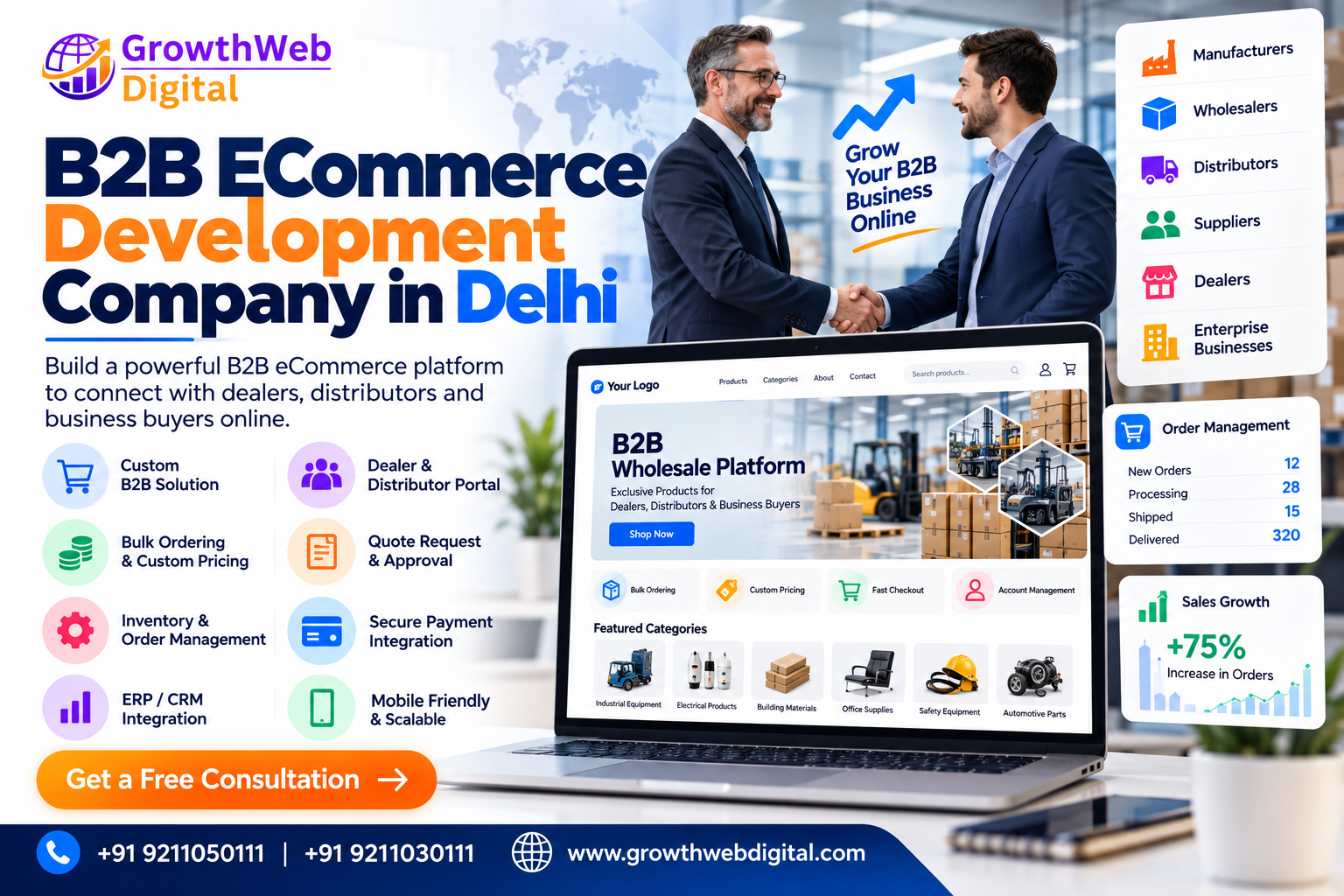
B2B Ecommerce Development Company in Delhi: Build a Powerful Digital Platform for Business Growth
No longer reliant solely on phone calls, email, spreadsheets, or offline sales representatives, businesses can now manage products, customers, pricing, orders, payments, quotations, and business relationships online with a dedicated B2B ecommerce platform
When looking for a B2B Ecommerce Development Company in Delhi, it's important to choose the right kind of development partner. Because B2B ecommerce websites are often more complex than regular retail ecommerce stores, choosing the right development partner is critical.
A B2B ecommerce platform may include elements such as:
• Customer-specific pricing
• Bulk ordering
• Minimum order quantity
• Dealer login
• Distributor management
• Quotation request
• Payment terms
• Inventory integration
• Custom dashboards
At GrowthWeb Digital, B2B ecommerce solutions can be designed according to specific business requirements to create a secure, scalable, and easy-to-manage online selling platform.
B2B Ecommerce Development
B2B Ecommerce Development is the process of creating an online platform where one business sells products or services to another business.
Unlike a normal B2C (business-to-consumer) ecommerce website, where individual customers purchase products, B2B ecommerce often includes:
• Manufacturers
• Wholesalers
• Distributors
• Dealers
• Retailers
• Suppliers
• Exporters
• Corporate buyers
B2B orders may involve larger quantities, negotiated pricing, credit terms, quotations, and repeat purchases.
Because of these requirements, a B2B ecommerce website requires specialized functionality.
Why Businesses Need B2B Ecommerce Development
Traditional B2B sales processes often rely heavily on manual communication.
A customer may call a salesperson, request a catalogue, ask for pricing, confirm stock, send a purchase order, and wait for order confirmation.
A B2B ecommerce platform can streamline many of these steps.
Business customers can login and browse products, check pricing, place orders, download documents, and manage previous purchases all in one centralized system.
This can help businesses improve:
• Order management
• Customer experience
• Sales efficiency
• Product visibility
• Dealer communication
• Data management
• Business scalability
1. Customized Pricing
One of the most important aspects of a B2B ecommerce website is customized pricing.
Different customers may have different prices based on:
• Order quantity
• Dealer level
• Distributor agreement
• Customer category
• Negotiated contract
• Purchase history
A custom B2B platform can display the correct price after the customer logs into their account.
This can save time and confusion for customers.
2. Bulk Ordering
B2B customers often purchase products in bulk.
A good B2B ecommerce website should make bulk ordering easy.
Some useful features may include:
• Quantity selection
• Bulk add-to-cart
• Quick order forms
• SKU-based ordering
• Repeat orders
• Product quantity tables
This saves time for regular business customers.
3. Minimum Order Quantity
Many manufacturers and wholesalers have minimum order requirements.
A B2B ecommerce platform can automatically apply:
• Minimum quantity per product
• Minimum order value
• Quantity multiples
• Category-specific rules
This prevents customers from placing orders below your business requirements.
4. Request for Quotation
Not every B2B transaction has a fixed price.
Some businesses need a quotation before confirming an order.
A Request for Quotation feature can allow customers to select products, mention required quantities, add special requirements, and submit enquiry for a customized quotation.
This feature is particularly useful for manufacturers, exporters, industrial suppliers, and project-based businesses.
5. Dealer and Distributor Login
A custom B2B ecommerce platform can provide separate login areas for dealers and distributors.
After logging in, the user may see:
• Special pricing
• Product availability
• Previous orders
• Invoices
• Payment status
• Product catalogues
• Offers
• Order tracking
This creates a more organized business relationship.
6. Product Catalogue Management
B2B businesses often have large product catalogues.
A good ecommerce platform should allow administrators to manage all aspects of products, including:
• Product categories
• Product specifications
• Technical details
• Images
• PDFs
• Brochures
• Prices
• Stock information
Customers should also be able to search and filter products easily.
7. Advanced Product Search
B2B buyers often know exactly what they want.
They may search by:
• Product name
• Model number
• SKU
• Category
• Brand
• Technical specification
An advanced search system can help customers find products quickly.
This is especially important for websites with hundreds or thousands of products.
8. Inventory Management
Inventory management is a important aspect of B2B ecommerce.
The system can display:
• Available stock
• Low-stock status
• Out-of-stock products
• Expected availability
Businesses may also integrate the ecommerce website with an existing inventory or ERP system.
This can help reduce manual stock updates.
9. Order Management
A B2B ecommerce system should provide clear order management.
Customers should be able to see:
• Order number
• Products ordered
• Quantity
• Order value
• Payment status
• Shipping status
• Previous orders
Administrators should also have a dashboard to manage and update orders.
10. Repeat Ordering
B2B customers often buy the same products, repeatedly
A repeat order feature can make this process easier.
Instead of searching for all products, the customer can view an old order and reorder selected products.
This can improve convenience and save time.
11. Payment Integration
A B2B ecommerce website may include different payment methods.
Depending on business requirements, these can include:
• Online payment
• Bank transfer
• UPI
• Credit card
• Debit card
• Payment against invoice
Some businesses may also provide approved customers with credit terms.
The payment workflow should match your actual business process.
12. Customer Credit Management
Certain B2B businesses provide customers with credit limits.
A custom platform may allow administrators to manage:
• Credit limit
• Outstanding amount
• Payment due date
• Available credit
• Payment history
This can make customer account management more organized.
13. Invoice Management
Business customers often need invoices and related documents.
A B2B ecommerce system can allow users to view, download, and check payment history and outstanding amounts.
This can reduce reliance on manual email communication.
14. CRM Integration
B2B ecommerce can be integrated with CRM software.
This can help businesses manage:
• Customer information
• Leads
• Sales activity
• Follow-ups
• Purchase history
• Account managers
Integration can create a better view of each business customer.
15. ERP Integration
Manufacturers, wholesalers, and large businesses may already use ERP software.
A B2B ecommerce platform can sometimes be connected with ERP systems to synchronize:
• Products
• Pricing
• Inventory
• Orders
• Customers
• Invoices
This can reduce duplicate data entry.
16. Mobile-Friendly B2B Ecommerce Website
Business buyers also use smartphones.
Your B2B ecommerce website should therefore be mobile-friendly.
This means it works properly on:
• Desktop
• Laptop
• Tablet
• Mobile
A mobile-responsive design makes it easier for customers to browse products, check prices, submit enquiries, and place orders while travelling or working remotely.
17. Secure B2B Ecommerce Development
A B2B ecommerce website may contain sensitive business information.
Security features should include:
• Secure customer login
• Role-based access
• SSL certificate
• Password encryption
• Secure payment processing
• Data validation
• Database protection
• Regular backups
Security should be considered throughout the development process.
18. Role-Based Admin Access
Large B2B businesses may have multiple team members managing the platform.
Different roles may include:
• Super Admin
• Sales Manager
• Accounts Team
• Order Manager
• Product Manager
Each user can receive access only to the functions they need.
This helps improve security and workflow.
19. B2B Ecommerce for Manufacturers
Manufacturers can use B2B ecommerce to sell directly to:
• Dealers
• Distributors
• Retailers
• Bulk buyers
• Corporate customers
The platform can display product specifications, minimum order quantities, dealer pricing, downloadable catalogues, and enquiry options.
This can help expand business beyond traditional sales channels.
20. B2B Ecommerce for Wholesalers
Wholesalers often manage many products and regular buyers.
A B2B ecommerce website can simplify:
• Bulk ordering
• Pricing
• Stock checking
• Repeat orders
• Customer accounts
This can reduce manual order processing.
21. B2B Ecommerce for Distributors
Distributors may need customized portals where business customers can login and order from an approved catalogue.
The platform can include:
• Regional pricing
• Customer-specific products
• Inventory visibility
• Payment terms
• Order history
This helps create a more efficient distribution network.
22. B2B Ecommerce for Exporters
Export businesses can use B2B ecommerce platforms to showcase products to international buyers.
Important features may include:
• Product catalogues
• Export specifications
• Certifications
• MOQ
• Quote request
• International enquiries
The platform can also be supported with country-wise SEO and digital marketing campaigns.
Benefits of Choosing a B2B Ecommerce Development Company in Delhi
Working with an experienced B2B Ecommerce Development Company in Delhi can provide several benefits.
Custom Development
Your platform can be developed around your actual sales process.
Local Communication
Businesses in Delhi NCR may find it easier to meet and discuss the project with a local development partner.
Better Integration
Custom APIs, CRM, ERP, payment, and other integrations can be developed based on requirements.
Future Scalability
The platform can be built to support more customers, sellers, products, and transactions over time.
Ongoing Support
A professional development company can assist with updates, maintenance, performance improvements, and new features.
Important Features of a B2B Ecommerce Website
A modern B2B ecommerce solution may include:
• Customer registration
• Approval-based accounts
• Dealer login
• Distributor login
• Customer-specific pricing
• Bulk ordering
• Minimum order quantity
• Quote request
• Product catalogue
• Inventory management
• Order tracking
• Payment integration
• Invoice downloads
• Repeat ordering
• Admin dashboard
• CRM integration
• ERP integration
The exact features should be selected according to your business model.
How to Choose the Right B2B Ecommerce Development Company
Before selecting a development partner, discuss your complete workflow.
The company should understand:
• Who your buyers are
• How pricing works
• How orders are processed
• Whether you have dealers or distributors
• Which integrations are required
• How payments are managed
• What reports are needed
You should also evaluate:
• Development experience
• UI/UX capability
• Security practices
• Mobile responsiveness
• Technical support
• Scalability planning
Avoid choosing a company only because it provides the lowest quotation.
A B2B ecommerce platform may become an important part of your long-term sales operations.
B2B Ecommerce Development Company in Delhi – GrowthWeb Digital
GrowthWeb Digital develops digital solutions for businesses that want to build customized B2B ecommerce platforms.
Depending on your requirements, the solution can include:
B2B Ecommerce Website Development + Dealer Portal + Distributor Portal + Bulk Ordering + Custom Pricing + Quote Management + Payment Integration + CRM/ERP Integration
The focus is on creating a platform that is easy for customers to use and simple for your team to manage.
A strong B2B ecommerce website should be:
Fast + Secure + Mobile-Friendly + Scalable + Easy to Manage
Why B2B Ecommerce Is Important for Future Growth
Business buyers increasingly expect convenient digital experiences.
They want to check products, prices, stock, invoices, and previous orders without waiting for manual responses.
A B2B ecommerce platform can make your business available to customers 24/7.
It can also support expansion into new markets because customers can discover your products and submit business enquiries online.
However, technology alone is not enough.
Your ecommerce platform should also provide accurate product information, professional support, reliable fulfilment, and a simple customer experience
Conclusion
Choosing the right B2B Ecommerce Development Company in Delhi can help manufacturers, wholesalers, distributors, suppliers, and enterprise businesses modernize their sales processes.
A professionally developed B2B platform can simplify customer management, bulk ordering, pricing, payments, quotations, inventory, and order tracking.
The most effective B2B ecommerce solutions focus on:
Easy Ordering + Custom Pricing + Business Automation + Secure Technology + Scalable Growth
If your business wants to develop a custom B2B ecommerce website, dealer portal, distributor portal, wholesale ecommerce platform, or marketplace, GrowthWeb Digital can help create a solution based on your business requirements.
📞 +91 9211050111 | +91 9211030111