Digital Marketing Strategy: Complete Guide for Business Growth
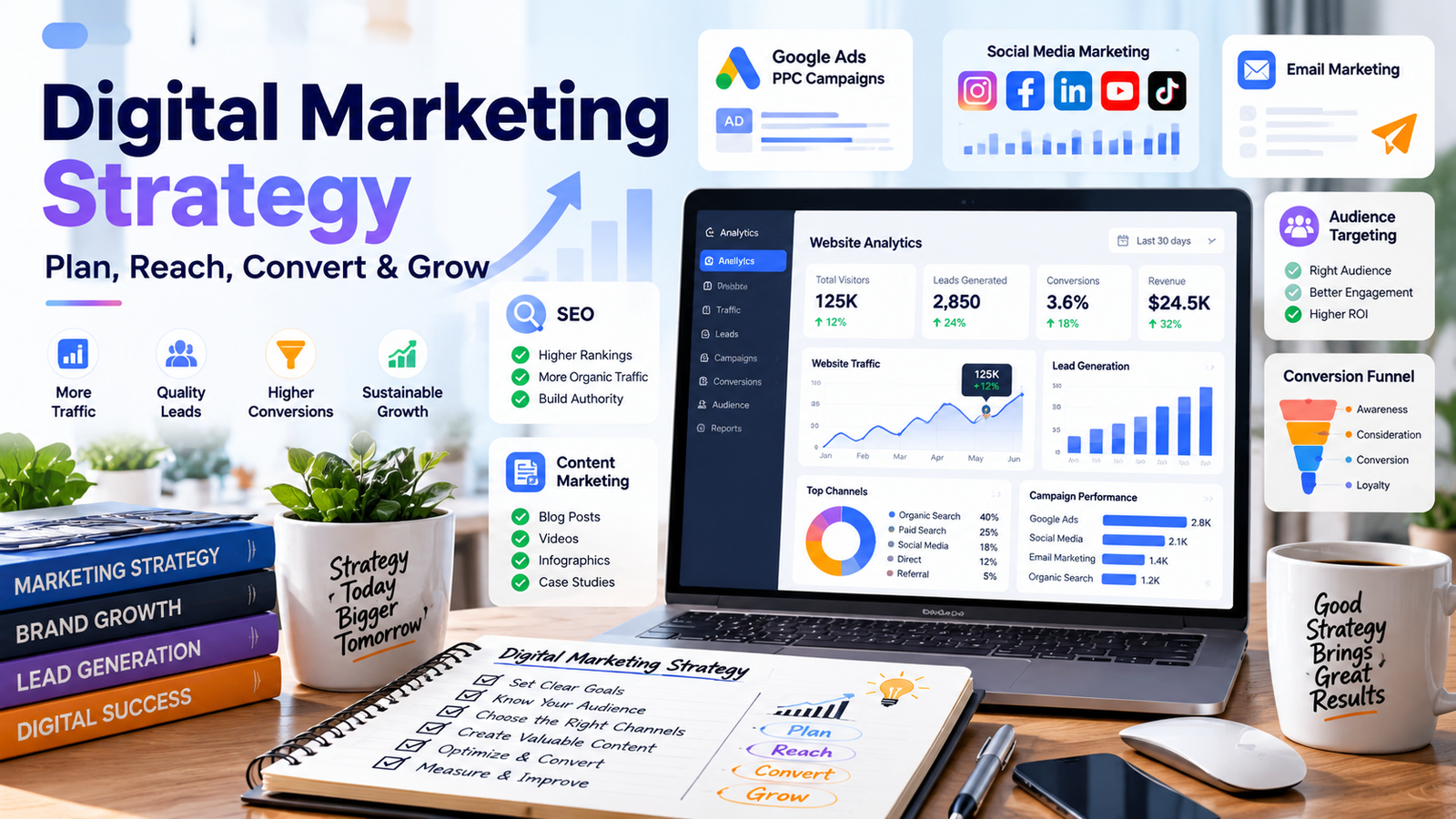
A business needs a proper marketing plan integrating SEO, ads, content, social media, email, website and conversion tracking.
Whether you are a start-up, small business, ecommerce, B2B, professional service, or an established company, a well-planned digital marketing strategy can help you get the best value out of your budget.
In this guide, we will discuss what is a digital marketing strategy, why it is important, what channels to use for marketing, and how to create a business digital marketing strategy.
What is a Digital Marketing Strategy?
A digital marketing strategy is a documented planning outlining how a business intends to use online channels to meet its marketing objectives.
A business marketing objectives could be to drive traffic, gain leads, build brand awareness, boost sales, expand geographically, enhance credibility, improve search engine ranking, increase engagements, retain customers, among others.
A company’s digital marketing strategy should be informative and not focused on a single channel. The plan should be realistic and research-based. A business must consider its budget, business goals, audience, competitors, and niche before developing a marketing strategy.
Why is a Digital Marketing Strategy Important?
A digital marketing strategy is important because it aligns a company’s entire marketing activity. Without a marketing plan, random marketing tactics that do not complement each other are implemented.
Examples of poor marketing practices include:
• Running Google ads without landing pages
• Implementing social media marketing without a content strategy
• Having a website with poor SEO optimization among others
A digital marketing strategy should be a roadmap that a business follows while executing its marketing campaigns. It should also help in addressing questions such as:
• Who is the target audience?
• What marketing channels to use?
• What marketing message to develop?
• What keywords to target?
• How much to spend on advertisements?
• What marketing metrics to track?
• How to optimize the best-performing campaigns?
With that said, let us look at steps to develop a business digital marketing strategy.
1. Define Business Objectives
The first step in digital marketing strategy development is to define business objectives. A company should set realistic goals that it wants to achieve using its online marketing campaigns.
Good examples of marketing goals are;
To get 100 qualified leads monthly from Google Ads and SEO.
Increase organic traffic
Drive more phone inquiries
Boost ecommerce sales
Build brand awareness
Expand into new markets
Grow a social media following
Increase customer retention
The objectives will inform the marketing strategies that a company will use to meet its goals.
2. Determine the Target Audience
Understanding who to sell to is often the primary step in any successful marketing campaign. A company should research and collect information about its ideal customer.
Such information includes:
• Demographic details like age, gender, and location
• Preferences and interests
• Industry
• Challenges
• Buying behavior
• Communication channels they are comfortable with
• Preferred search engines and keywords
• Budget
• How they make purchasing decisions
For instance, a B2B manufacturing company could be targeting business owners and managers in the construction industry. As such, the company could use Google and LinkedIn to network with its prospects.
A clothing brand could be targeting Gen Z and millennials shopping on Instagram and Facebook. The company could engage influencers and run ads on Meta to market its brand and products.
3. Conduct a Competitive Analysis
A company should analyze the online presence of its major competitors. This process will help the firm to identify areas to improve on and take a more competitive position within its niche. Some of the aspects to compare with competitors are:
• Website
• SEO
• Google ranking
• Google Ads
• Social media
• Offers
• Landing pages
• Reviews
• Prices
• Content
A business should avoid copying its competitors’ marketing strategies. Instead, it should conduct a SWOT analysis and implement virtual strategies that the other companies are not using. For instance, if a competitor has a poor website but aggressive advertisement, the former can focus on developing a responsive website.
4. Develop a Powerful Website
A website is the backbone of a business’s online presence. All other digital marketing activities such as advertisements and SEO are directed towards to the website. Hence, one should invest in developing a responsive and attractive website.
A business should consider developing an SEO-friendly and eye-catching landing page. The website should be easy to navigate and provide information about the business and its services. Important pages such as the About Us and Contact should be easy to access.
Other than visual appeal, a business website should have the following features;
• Mobile responsiveness
• Fast in loading
• Easy navigation
• Professional design
• SSL (Secure)
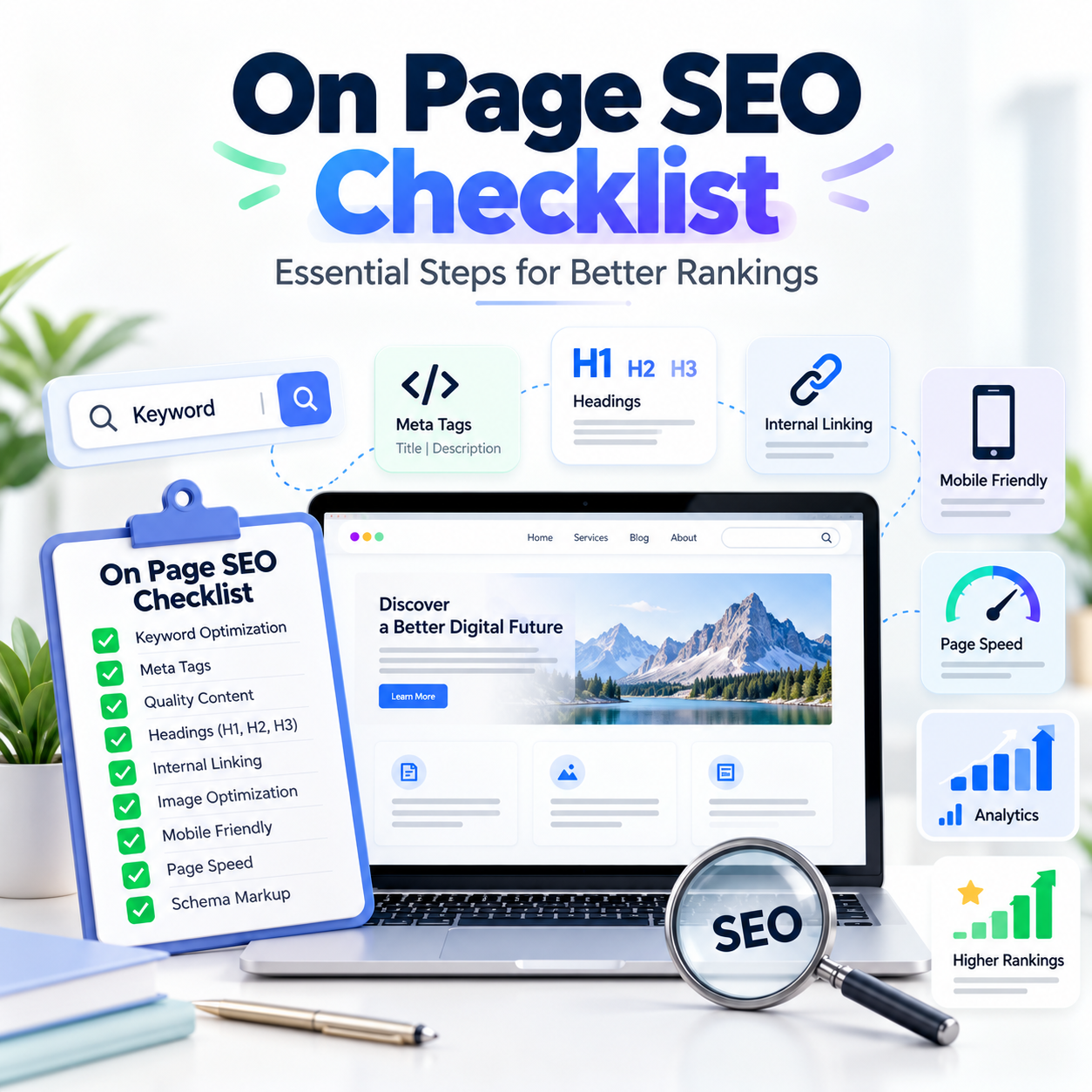
• SEO-friendly
• Customer-focused
• Easy contact options
5. Optimize for Search Engines
Search Engine Optimization (SEO) should be an integral part of a business’s digital marketing strategy.
SEO helps to improve a website’s ranking on search engines such as Google. A company should set realistic SEO goals and determine the most suitable strategy to achieve its targets.
A business should invest in SEO services to help it rank higher on Google for targeted keywords.
For instance, a digital marketing agency could decide to optimize its website for the following keywords.
• Digital marketing services
• SEO company
• Website designing company
• Google Ads management
• Lead generation services
SEO activities should be tracked and monitored on a monthly basis.
6. Create a Powerful Content Marketing Strategy
Content marketing is important as it educates the audience and encourages them to take action. A company should identify the type of content that its audience prefers. Examples of contents are articles, blogs, videos, case studies, infographics, and social media posts.
A business should also consider developing the following contents;
• How to do guides
• FAQ
• Company blog
• Testimonials
• Case studies
• Email newsletter
• Industry-related content
• How to-videos
For instance, a digital marketing agency could develop informative content such as:
• How to rank a website on Google
• On page SEO checklist for 2023
• Digital marketing strategy
• Google ads lead generation
• Ecommerce website development cost
• SEO vs Google ads
7. Run Google Ads for Quick Results
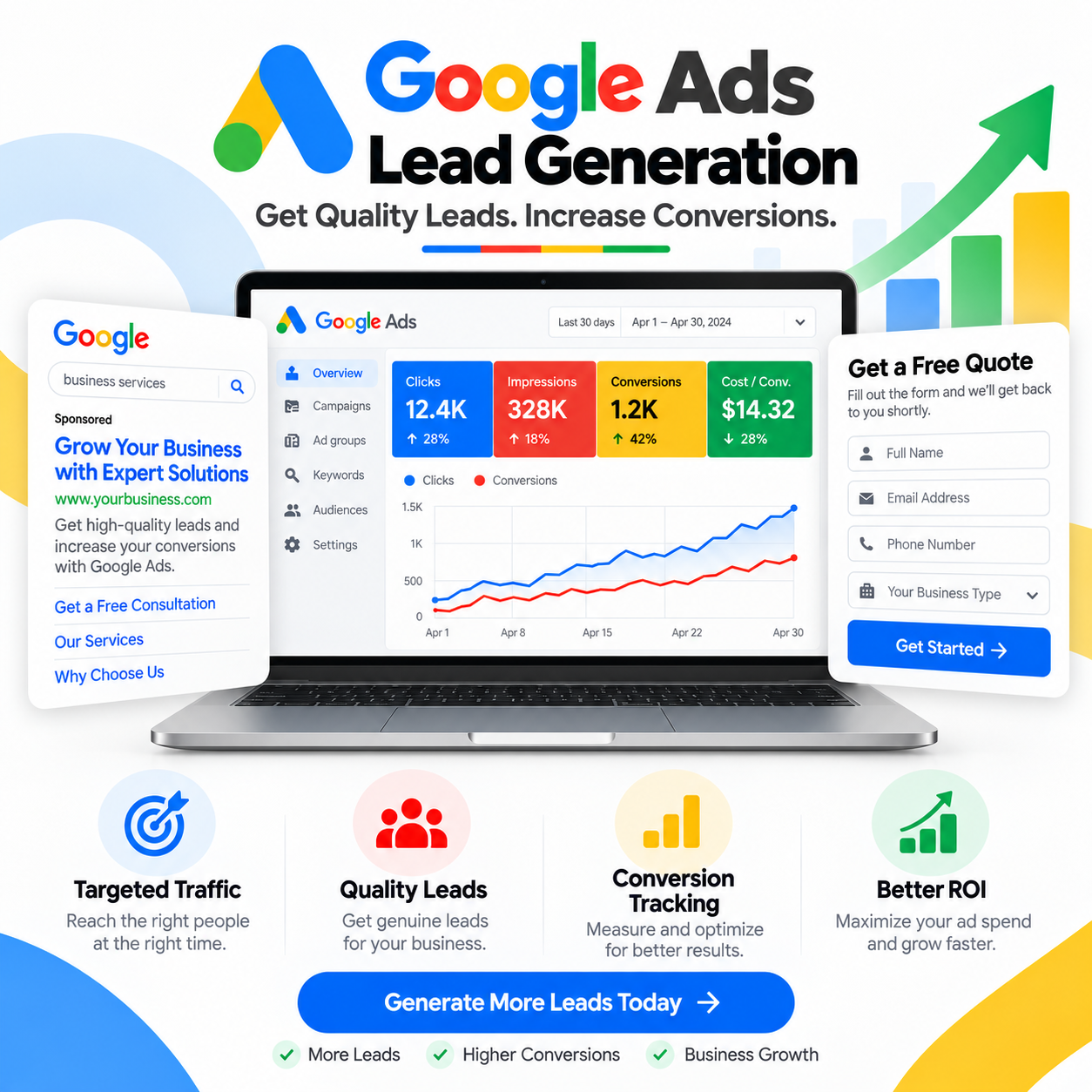
Google Ads could be the most effective marketing tool for generating leads and increasing conversions. The ads are suitable for targeting local and international clients depending on the selected location and language.
Google Ads are appropriate for businesses offering the following services:
• Lead generation
• Local services
• Ecommerce
• B2B marketing
• High-end services
• New product launch
A company should implement the following practices when running Google Ads;
• Target the right keywords
• Use negative keywords
• Write compelling ad headlines
• Select the appropriate location
• Develop targeted landing pages
• Track keyword performance
• Measure landing page performance
• Optimize profitable campaigns
Moreover, the company should invest in Google Ads conversion tracking to monitor the effectiveness of its ad campaigns.
8. Run Meta (Facebook) Ads
Meta (Facebook) is one of the most powerful digital marketing channels. It allows businesses to market their products and services digitally cost-effectively.
Businesses should identify and invest in the most appropriate Meta marketing tools such as ads, business insights, and shop. The following business marketing activities are ideal for Meta:
• Brand awareness
• Lead generation
• Ecommerce marketing
• Remarketing
• Audience targeting
• Local targeting
• Engagement
For better results, a business should create compelling and high-quality ad content. A strong call to action should be included in the ad campaign.
9. Develop a Social Media Strategy
Social media is vital for brand building, lead generation, and customer engagement. A business can easily connect to its target audience and market its brand effectively. The following are the most appropriate social media platforms for marketing.
• YouTube
• X
A company should avoid using all the social media platforms. Instead, it should identify the most popular platforms among its target audience and use them. Here are some tips to help boost business social media marketing;
• Upload interesting content such as videos and images about the company’s services and products.
• Develop informative and engaging posts about the industry.
• Use social media insights to understand the audience’s interests.
• Upload testimonials and reviews.
• Post weekly and monthly newsletters.
• Update the audience about the company’s achievements and news.
10. Leverage Local SEO if You Operate Within a Specific Location
Local SEO is essential for companies that provide services or sell products within a specific city or location. A business should work on the following local SEO strategies;
• Google Business Profile optimization
• Local keywords
• Updating contact details
• Reviews
• Local citations
• Location-specific pages
• Local content
For instance, a company operating in Delhi could optimize its website for the following keywords.
• Digital marketing company in Delhi
• SEO company in Delhi
• Website designing company in Delhi
11. Implement Email Marketing
Email marketing is a powerful tool for nurturing and retaining customers. The following are the most effective email marketing automation activities.
• Lead nurturing
• Newsletters
• Email drip campaigns
• Offers
• Follow-up emails
• New customer welcome emails
• Abandoned cart emails
Email marketing has an advantage over social media as businesses do not rely on a third-party platform to connect with the audience directly.
12. Develop Landing Pages for Better Conversions
A landing page is a web page that is designed to persuade a website visitor to take a specific action. A company should develop a landing page for each of its marketing campaigns.
For instance, if a business runs Google Ads for SEO services, a prospective lead should be directed to an SEO services landing page. A landing page should have engaging contents and include trust signals such as testimonials and trust badges.
Other than testimonials, a landing page should feature the following;
• A strong headline
• Main selling points
• Company services
• Contact details
• Call-to-action
• Mobile friendly
13. Generate Leads for Business Growth
A company should focus on generating high-quality leads for sustainable revenue growth. A business lead could be generated from Google Ads, Meta ads, SEO, landing pages, and social media marketing.
All marketing channels should be integrated as they complement each other. A company should also collect and store lead generation sources to identify the most productive channel. A business should use the following lead generation tools;
• Landing pages
• Google forms
14. Track Conversions
One of the best aspects about digital marketing is its ability to track conversions. A company should install Google Analytics and Google Ads conversion tracking to monitor its marketing performance. A business should also track the following marketing conversions.
• Form submissions
• Phone calls
• WhatsApp clicks
• Purchases
• Quote downloads
• Video views and plays
• Appointment bookings
Conversions are useful in determining which marketing activities are performing better than others.
15. Monitor Key Performance Indicators (KPIs)
A company should measure the performance of its marketing campaigns using KPIs. Different business objectives will have unique performance indicators. Here are some examples of KPIs that a business can use.
• Website traffic
• Organic traffic
• Click-through rate (CTR)
• Cost per click (CPC)
• Cost per lead
• Conversion rate
• Return on ad spend (ROAS)
• Leads
• Sales
• Engagement rate
• Search rankings
It is important to note that a business should not track random KPIs as there is no set KPI that all companies can use. Businesses should also avoid tracking vanity metrics such as likes and shares as they do not show progress.
16. Retarget Website Visitors
Not every person who visits a website will purchase from the first visit. A business should implement remarketing to encourage website visitors to revisit the website and engage with the brand.
A company should use Google Ads and Meta ads to retarget website visitors. A business can also use the following remarketing techniques;
• Remarketing to visitors
• Retargeting inactive website users
• Retargeting past purchasers
• Remarketing to users who abandoned carts
17. Combine SEO and Google Ads
A business should consider combining SEO and Google Ads to achieve the best results.
The two digital marketing strategies should not be implemented independently as they complement each other.
A company can use Google Ads to target active search intent and use SEO to target long-tail keywords.
A business can use the performance insights of Google Ads to improve its SEO strategy. For instance, a company can use profitable keywords and locations identified from Google Ads to improve its SEO performance.
18. Create a Marketing Funnel
A marketing funnel enables a business to understand how a website visitor traverses from being aware of a brand to becoming a customer. A company should identify the marketing channels that nurture customers at different funnel levels.
The marketing funnel has the following stages;
• Awareness – At this level, a person has become aware of a brand.
• Consideration – The prospect has developed an interest in the business and is actively searching for a solution. Here, SEO and Google Ads can be used to capture the lead. A company can also use social media to engage the prospect.
• Conversion – The lead has decided to make a purchase. Here, a business should use landing pages to capture the lead’s information.
• Retention – The business has succeeded in selling its product or service. A company can utilize email marketing to keep the customer engaged and encourage repeat purchases.
19. Implement Personalization
A company should use personalization to improve its marketing activities. Personalization entails developing unique marketing messages for different target audiences.
For instance, a digital marketing agency can develop unique campaigns for different services such as website development, SEO, and google ads. The company can also use different campaigns for different locations such as Jaipur, Noida, Delhi, and Chandigarh.
20. Review and Optimize Marketing Activities
A company should regularly review and optimize its marketing activities. It is critical to ask the following questions;
• Which marketing channel is generating the best leads?
• Which campaign strategies are a waste of time and money?
• Which keywords are converting?
• Which web pages are getting more traffic?
• Which type of content is the audience more interested in?
• Which locations are generating more enquiries?
Using the above insights, a business can optimize its marketing activities. Digital marketing should be seen as a process that is continuous and should not be stopped even after initial improvements.
Common Digital Marketing Mistakes to Avoid
A business should avoid the following digital marketing mistakes;
• Trying to use all digital marketing tools at once
• Getting ads without tracking
• Neglecting SEO
• Using a poor landing page
• Having no content strategy
• Targeting the wrong audience
• Chasing followers
• Neglecting mobile optimization
• Not following up on leads
• Expecting every digital marketing activity to yield immediate results
Digital Marketing Strategy for Small Business
A small business owner should not start with a complex digital marketing strategy. Instead, the following affordable strategies are ideal for a small company.
• Developing a professional website
• Creating a Google Business Profile
• Local SEO
• SEO content
• Google Ads
• Social media
• Basic lead tracking tools
A small business owner should focus on the most productive digital marketing channels.
Digital Marketing Strategy for B2B
A B2B company should implement the following digital marketing strategies.
• SEO
• Google Ads
• LinkedIn marketing
• Case studies
• Industry-related content
• Lead forms
• CRM
• Email nurturing
Digital Marketing Strategy for Ecommerce
An ecommerce company can use the following digital marketing mix;
• SEO
• Google Shopping
• Google Ads
• Meta ads
• Social media marketing
• Remarketing
• Email marketing
• Product content
A company should focus on product listing and visibility, customer engagement, conversion rate improvement, and repeat sales.
Digital Marketing Strategy with GrowthWeb Digital
At GrowthWeb Digital, we specialize in helping companies to develop profitable digital marketing strategies that deliver sustainable results. We offer a wide range of digital marketing services that can be tailored to fit a company’s specific requirements.
Our digital marketing services include:
• Search Engine Optimization
• Google Ads
• Meta (Facebook) Ads
• Social Media Marketing
• Lead Generation
• Website Designing
• Website Development
• Ecommerce
• Content Marketing
• Country Wise Promotion
A company should implement an integrated digital marketing mix instead of using various marketing channels independently.
Final Digital Marketing Strategy Checklist
Before finalizing a digital marketing strategy, a company should ensure that it has covered the following aspects.
• Set business objectives
• Identified the target audience
• Conducted a competitor analysis
• Developed a professional website
• Implemented an SEO strategy
• Created a content calendar
• Set up a paid ad campaign
• Set up a social media strategy
• Set up landing pages
• Set up conversion tracking
• Set up lead generation
• Set up remarketing
• Set up analytics
• Set up KPIs
• Reviewed marketing activities
Conclusion
A successful Digital Marketing Strategy does not mean adopting all online marketing channels.
Instead, a company should identify the most appropriate marketing channels, target the right audience, and track the best marketing activities.
A successful digital marketing strategy mix should consist of a website, SEO, content marketing, paid online advertisements, social media marketing, lead generation, analytics, and optimization.
A company should set realistic marketing objectives, target the right customers, invest in a strong website, and measure the performance of its marketing campaigns.
A well-implemented digital marketing strategy will eventually pay off by helping a company to achieve its marketing goals. For professional digital marketing, SEO, Google Ads, website building, and lead generation services, contact GrowthWeb Digital.